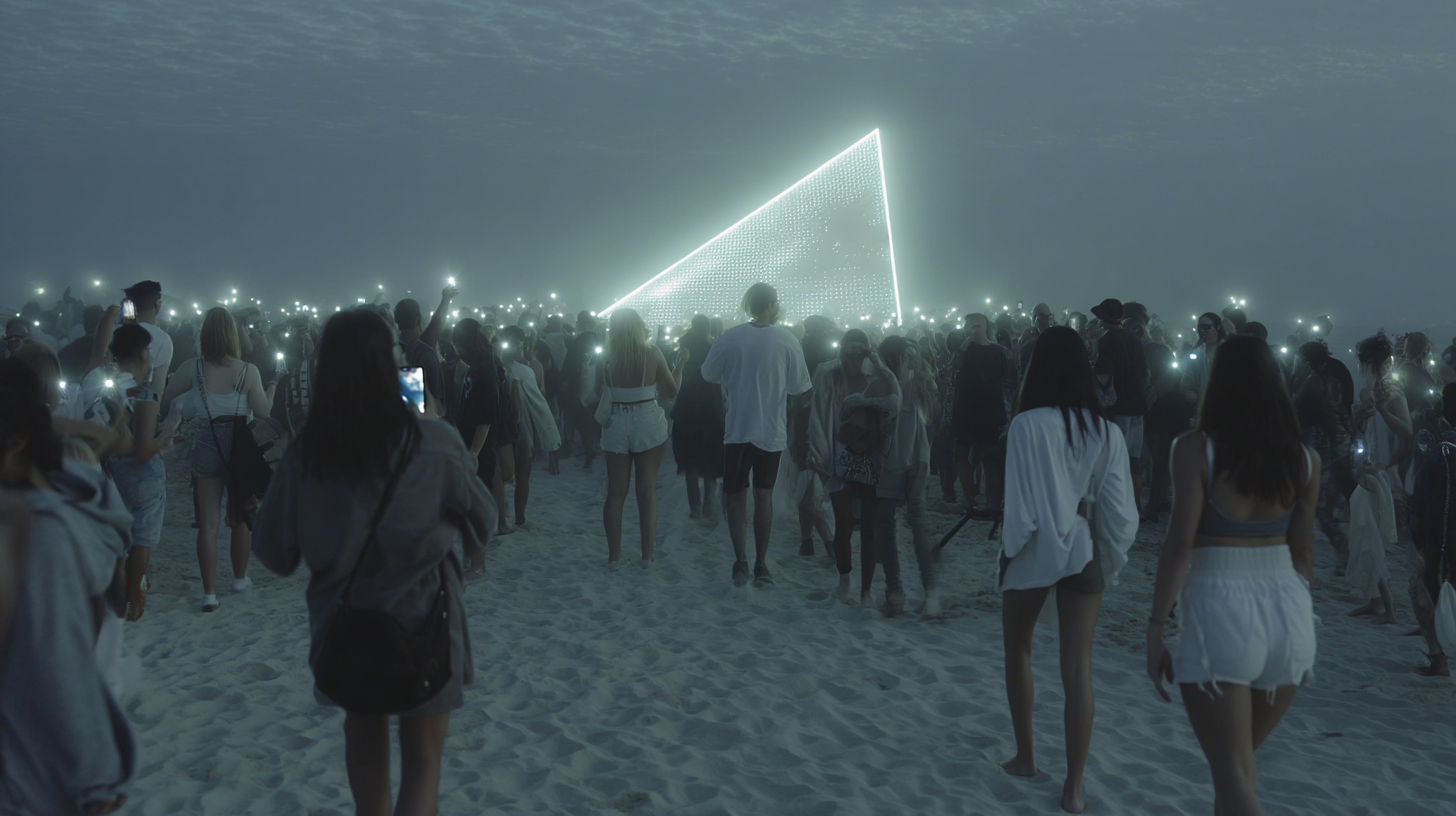
I arrived late. The sun had already gone down and dusk had settled over the beach. What I saw first was not an installation in the tidy sense, but a glowing, uneven triangle standing upright against the ocean and a grey evening sky, surrounded by a percolating crowd. From a distance it looked less like art than like an arrival: some strange beacon or sci-fi object, reflecting the last calm, urgent traces of daylight while the beach around it pulsed with a far more hectic human energy. White sand under my feet made the whole thing feel both ancient and oddly current.
The closer I got, the less the object seemed to exist alone. The crowd thickened around it in rings, dispersed at the perimeter and dense near the center, phones lifted, screens multiplying the glow. Classical music drifted over the beach and mixed with voices, movement, and the nervous pleasure of people gathering around something they felt was worth witnessing. Frankly, close inspection of the installation itself was not the event for me. The event was what happened as I approached it. By the time I stood slightly off to the side, without pushing through the densest part of the crowd, I understood that half the piece was not the structure at all. It was the organism around it.
That night clarified something I have been circling for a while. I do not primarily respond to artworks as objects. I respond to states. Visual form matters, but often as an entry point to something deeper: an emotional shift, a change in collective attention, a field that makes people more aware of themselves and of each other. Some artists build objects. Some build atmospheres. Some build conditions under which meaning happens. What struck me in Es Devlin’s installation was that the audience was not incidental to the work. The audience was part of its material.

A wide dusk photograph of Es Devlin’s beach installation on Miami Beach, showing the illuminated triangular form and the crowd gathered around it.
Too much immersive work gets flattened into apparatus. People talk about spectacle, scale, technology, engineering, the obvious mechanics of how a thing was built. But that kind of reading misses the actual event when the event is taking place not only in the structure, but in the social field that gathers around it.
What I felt on the beach was not simply that a luminous object had attracted a crowd. I felt that the work was organizing people. The closer they moved, the denser the charge became. Anticipation was part of the composition. So was hesitation. So was the way phones rose in the air, not only to document, but to hold onto something already disappearing. The screens multiplied the glow, but they also made visible the shared impulse behind them: people wanted proof that they had stood inside something worth recording, something that had sharpened their senses and gathered them into a common mood.
This is what I mean by social organism. Not audience participation in the usual cheerful sense. Not interactivity. Not crowd as backdrop. I mean that the work exceeded its physical boundaries and extended into bodies, behavior, pacing, expectancy. It used human clustering the way another artist might use shadow, repetition, or sound. The crowd was not an accident. It was one of the ways the piece became legible.
A photograph of the Design Miami event screen announcing “Language, Life and Light: A Conversation with Es Devlin and Alberto Cavalli,” which led to the in-person encounter described in the essay.


A wide photograph of Es Devlin speaking onstage at Design Miami, showing the audience, stage environment, and public context of the encounter referenced in the essay.
A few days earlier, I had seen Es Devlin at Design Miami almost by accident. I stopped at the talks area, looked at the schedule, and realized she was speaking right then. So I walked in and listened. I saw her daughter there too. Afterward, I asked for a picture.

A brief encounter after the talk, before the beach installation sharpened its meaning.
Maria Lankina and Es Devlin at Design Miami
That encounter matters here, but not for the usual reasons. I am not interested in artist proximity as a social trophy. What stayed with me was something more elemental: the feeling of authorship made public. Not just a person who makes work, but a person whose work, speech, presence, and scale of thought all belong to the same world. By the time I reached the beach installation later, I was not arriving neutral. I was arriving already tuned to a frequency.
There are artists whose work you admire. Then there are artists whose work reveals what you value. The second kind matter more.
What Es Devlin’s work revealed to me is that what I value most is authorship. Ritual. Public emotional intelligence. The ability to create a condition in which awe is still possible.
I do not mean awe as spectacle or branding, as the contemporary demand to be impressed. I mean something older and harder to fake: the sense that one is more alive in the presence of a work than one was before encountering it. More awake. More porous. More available to feeling. More capable of perceiving that one is not alone in one’s own inner weather.
That kind of experience matters more to me than novelty. It interrupts mere existence and returns a person to living. Especially now, when so much public life feels accelerated, thinned out, and flattened into reaction, the ability to be in awe is not decorative. It is one of the few things that can still restore depth.
That recognition did not stay with Es Devlin. It turned and came back toward me.
For a long time, I have worked across images, atmospheres, shoots, paintings, visual systems, symbolic structures. But what that evening clarified is that the image itself is often not the end point for me. It is the threshold. What matters more is the state it opens: the shift in attention, the afterimage, the emotional rearrangement that lands a beat later.
This is why listening to visceral reaction matters. Understanding often comes later. It did for me here. First there was the pull. Then the field. Then the recognition. Then the language for what had happened. I am not here as an artist only to make pictures or objects. I am here to design states. To make conditions in which a signal can be felt, and in which people become, however briefly, more available to aliveness.
What matters to me now is not only what a work looks like, but what it gathers, what it permits, what it changes in the people around it. Certain artists reveal this with unusual clarity. They do not simply give us something to look at. They alter the field. They make people more aware of themselves, of one another, of the strange fact of being here at all.
That is why this matters beyond one evening on a beach, beyond one installation, beyond one admired artist. We live in a time that gives us endless stimulation and very little depth, endless images and very little transformation. When a work manages to gather people into a more alive condition, even briefly, it is doing more than decorating public space. It is reminding us of a human capacity we are in danger of losing.
If art still has a public function, perhaps it begins there: in the creation of conditions under which people can feel more awake, more together, more capable of wonder than they were a moment before. That is not everything art can do. But it is not a small thing.
Further Reading
To see how the project was framed institutionally and received publicly, start with Faena Art’s official presentation of Library of Us, then the Design Miami talk listing, and finally the Observer review, which gets closer than most to the installation’s contemplative force
- Faena Art: Library of Us
- Design Miami 2025: “Language, Life and Light: A Conversation with Es Devlin and Alberto Cavalli”
- Observer Review: “Es Devlin’s ‘Library of Us’ Was the Rare Miami Art Week Spectacle That Invited Quiet Contemplation”
Image Credits & Fair Use
This essay includes low-resolution images of artworks and photographs for the sole purpose of commentary, critique, and educational analysis in accordance with fair use principles. Full credits and source links are provided. No infringement is intended, and works remain the property of their respective rights holders.
If this essay resonated with you – share it or save it.