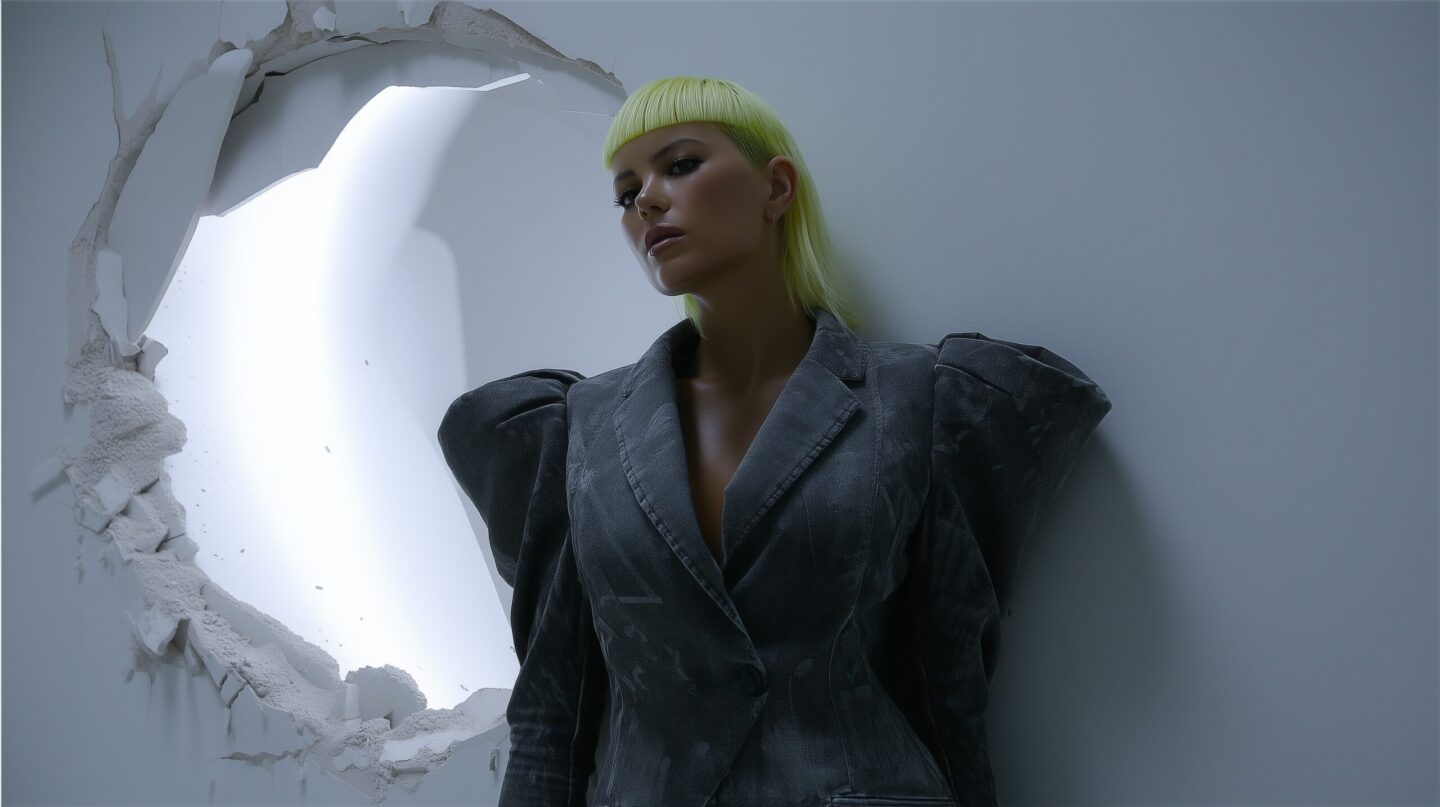
I watched a line of paint drip once in a white room so quiet I could hear the drip before I saw it land. The painter did nothing heroic. Gravity did the work, and still the room inhaled as if it had witnessed truth being born.
Later, I drew a line too straight on a sheet of paper and felt the temperature drop. No one booed. They simply looked away.
Somewhere between those two moments I began to suspect that “raw” might not be a description of a surface at all, but something closer to a social password.
Fetish of the Raw: The Art World’s Favorite Costume
The contemporary art world has a long and complicated relationship with the unfinished. Drips, glitches, torn edges, gestures that appear to have barely survived the act of making. We call them raw. We call them authentic.
But I sometimes find myself wondering when a visual style began to behave like a moral category, and why we so easily mistake a costume for a body.
There is a certain kind of work that the art world seems repeatedly drawn toward. It scratches. It stutters. It performs damage. It announces itself as real in the same way certain people declare themselves honest within the first five minutes of meeting you.
Rawness is supposed to function as evidence. The visible mark that says: I am not corporate. I am not slick. I am not a product.
And yet the longer I look, the more I notice that rawness itself has developed a grammar.
The grammar of the unfinished
The unfinished aesthetic now travels through galleries and screens with surprising efficiency. A scrawled line suggests intimacy. A glitch implies rebellion. A torn edge signals vulnerability.
These gestures speak quickly.
They tell the viewer: this is personal.
They tell the collector: this carries aura.
They tell the institution: this work belongs to the serious conversation of culture.
The gesture appears unguarded, therefore it feels brave. The surface appears unstable, therefore it feels true.
But what we call raw today is rarely as spontaneous as it looks. Often the drip is placed. The mistake is repeated until it appears convincingly accidental. The sketch-like gesture is rehearsed until it performs effortlessness.
This is not an accusation. It is simply what happens when visual languages become recognizable. Once a language proves powerful, it begins to standardize itself.
Styles harden. Signals circulate. And what once appeared unruly slowly becomes legible.
A history of unfinished things
Our attraction to unfinished surfaces is older than contemporary art.
In Romanticism, ruins were not merely rubble. They were staged as metaphysical evidence. A broken column or a half-erased fresco seemed to carry time within its body. The fragment promised access to something deeper than completion.
Modernism inherits this fascination with the visible trace. The brushstroke is no longer hidden inside illusion but displayed as proof of the body at work. Gesture becomes evidence of the moment of making.
Think of Pollock’s splatter or Twombly’s scrawl. The rhetoric of immediacy becomes central. The trace of the hand stands in for the presence of the real.
What has changed today is not the desire for unfinished things but the speed at which the unfinished circulates.
The raw look reads quickly. It travels easily across screens. It can often be summarized in a single word: authentic.
That word carries an enormous amount of cultural weight.
Rawness as currency
There is a reason the slick surface makes many viewers uneasy.
Finish suggests money.
Money suggests control.
And control sits awkwardly inside our romantic mythology of the artist.
Mess feels human. Mess suggests vulnerability. Mess appears resistant to the smooth efficiency we associate with corporations and algorithms.
So rawness becomes a promise: no mediation, no marketing, no performance.
Except that it often is a performance, and sometimes a very sophisticated one.
At this point an older word becomes useful. Not as an insult but as a mechanism.
The fetish
Freud used the word fetish to describe an object that carries an oversized psychological charge. Something stands in for something else and becomes emotionally amplified beyond its material reality.
In the art world, rawness sometimes functions in a similar way.
A drip begins to stand in for risk.
A tear begins to stand in for truth.
A glitch begins to stand in for rebellion.
The object becomes a portable unit of authenticity.
It can be bought, collected, exhibited, circulated.
The viewer reads sincerity in the surface.
The collector reads aura in the gesture.
The institution reads seriousness in the language.
Whether the artist actually felt authentic becomes almost secondary. The signal performs the work.
A narrowing language
Once a style begins to function as proof of authenticity, something else quietly happens.
Other surfaces start to look suspicious.
If unfinished equals real, then finish begins to appear compromised. If polished equals commercial, then craft becomes questionable. Pleasure becomes decorative. Precision becomes suspect.
The range of what can count as serious art narrows.
This narrowing is not merely aesthetic. Aesthetic hierarchies have always carried social hierarchies with them. They distribute legitimacy. They shape which kinds of labor, bodies, histories, and pleasures are allowed to count as meaningful.
When rawness becomes the passport, the border shifts.
And because I spend much of my life inside images, I sometimes feel that shift physically. I can sense the moment a room quietly agrees that a certain surface carries moral authority.
The drip is no longer just paint.
It becomes permission.
Seeing the costume
If rawness has become a costume, the solution is not to reject it.
Costumes are powerful. They tell stories. They stage emotions. Sometimes they reveal truths more clearly than nakedness ever could.
The difficulty begins when costume is treated as proof of virtue.
The unfinished gesture itself is not the problem. The automatic moral credit we grant it might be.
The raw look is no longer a rebellion. It is a style, and a highly successful one.
The more difficult question may be this: what does authenticity look like once it can no longer be recognized instantly?
Examples of the Fetish

ombly, Untitled (1968), Tate Modern Collection
Raw scrawls masquerading as spontaneous gesture; calculated immediacy.

Jean-Michel Basquiat, Untitled (1981), The Broad Collection
Iconic “authentic” mess – the aesthetic became a market language of rebellion.

Alberto Burri, Sacco series (1950s), Guggenheim Collection
Torn burlap, stitched and burned – fetishization of wound as truth.

Lucio Fontana, Concetto Spaziale (1960), MoMA Collection.
A single slash mythologized as rupture.

Rosa Menkman, Glitch Studies Manifesto (2010)
Digital error aesthetic elevated to institutional rebellion.
Interlude

I watched a line drip once,
and the room gasped.

I drew one too straight,
and they turned away.
Closing reflection
Rawness is a language. Like any language it can reveal or conceal.
When the appearance of authenticity becomes a recognizable aesthetic, we find ourselves in a strange situation. We must either repeat the approved signals of sincerity, or risk speaking in forms the room has not been trained to hear.
The unfinished gesture is not the enemy.
The fetish is.
And the question that returns, quietly, like that drip landing in the silence of a white room, is this:
If authenticity becomes a style we can recognize at a glance, what kinds of truth might we have stopped noticing?
This essay is part of an ongoing exploration of how surfaces and signals operate in contemporary art.
Read the companion essay:
Fetish of the Toy →
Image Credits & Fair Use
This essay includes low-resolution images of artworks and photographs for the sole purpose of commentary, critique, and educational analysis in accordance with fair use principles. Full credits and source links are provided. No infringement is intended, and works remain the property of their respective rights holders.
If this essay resonated with you – share it or save it.


Leave a Reply