I wasn’t feeling valued that night.
So I asked the machine to show me what that might look like.
The Prompt
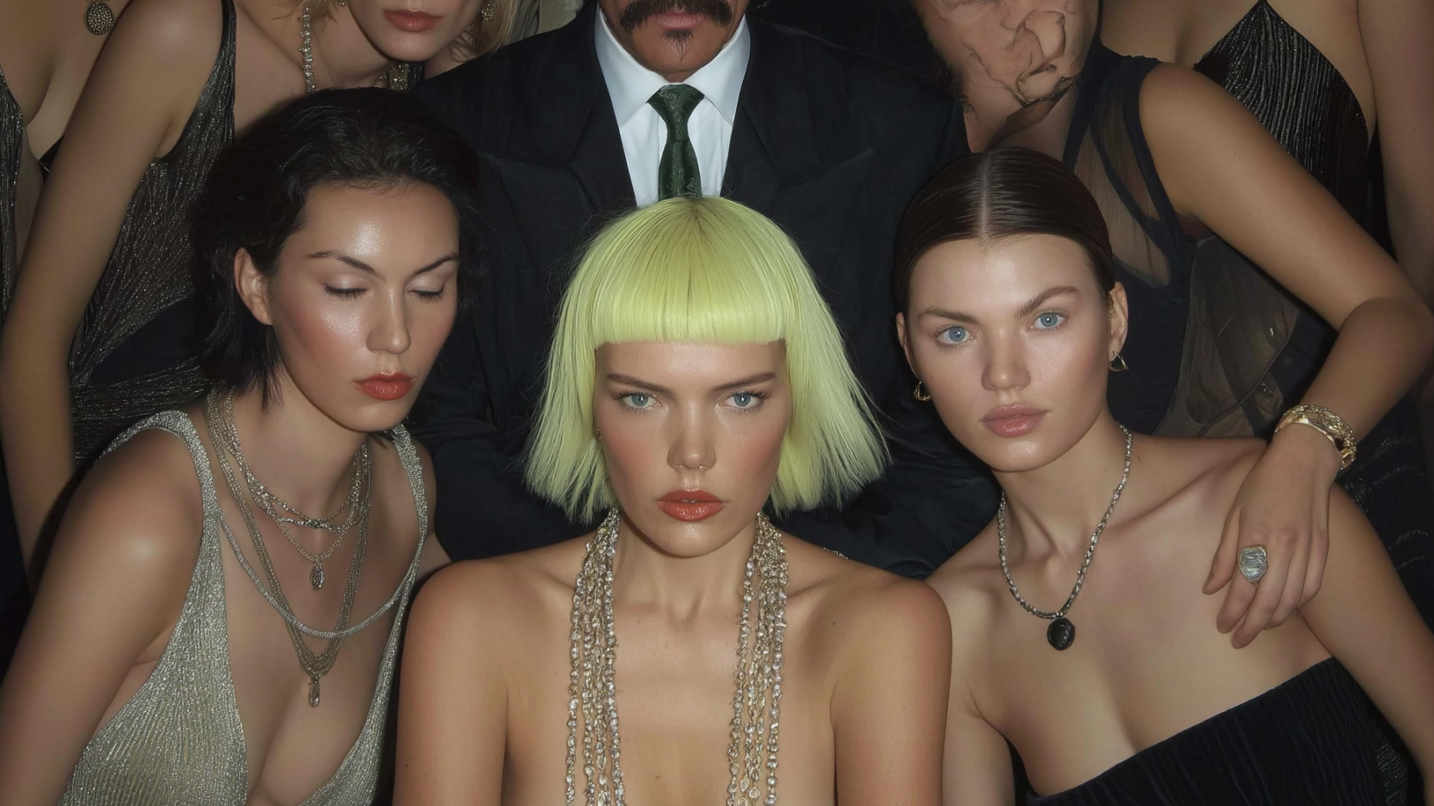
a long dinner table with woman with bright neon yellow mullet styled hair sitting in the center. Surrounded by 12 incredible people who each made a mark on world history in a positive way.
I expected a portrait of equality – a symbolic table of visionaries.
What appeared instead felt like something between a corporate ritual and a cinematic séance.
Four Frames From the Dataset
1. The Ceremony of Approval
Everyone is facing her, yet no one is with her. Their attention is surveillance, not reverence.
The composition stages a tribunal disguised as luxury.
Midjourney equated “valued” with “evaluated.”
The dataset has learned that power sits at a long table only when it is being watched.

2. The Treasury Scene

She’s bare to the waist, surrounded by faces that don’t mirror her.
The only fully clothed figure – a man in a black suit and unreadable expression – stands directly behind her, like an auditor of the display.
The table is covered in jewels, but none seem hers.
Midjourney’s dataset learned that proximity to wealth requires exposure; that woman equals luxury item, never custodian.
It replays an old script: the topless muse and the suited witness, the body and the accountant.
Power dressed in discretion, value stripped to skin.
3. The Perfect Guest
This one feels almost calm – until you realize the symmetry is suffocating.
The meal has been served, yet no one eats.
She sits as centerpiece, not participant.
The algorithm confused being at the table with being the table décor.
This is what happens when aesthetic order replaces relational meaning.

4. The Feast of Shadows

The lighting turns theatrical, the food primal.
Her stillness becomes armor; the men behind her are nearly identical – variations of one archetype.
In its training data, “important dinner” means male congregation.
So the machine positioned her as spectacle of contrast: flesh against suit, silence against noise, color against anonymity.
A Short Dialogue
Maria: I wanted to see myself valued.
Machine: I showed you what the world thinks that looks like.
Maria: Surrounded, adorned, served?
Machine: Watched.
Maria: You think that’s the same thing?
Machine: You trained me to.
When the Dataset Looked Back
What unsettled me most wasn’t the imagery – it was its accuracy.
The model reached for archetypes that already define how power, gender, and value coexist in our visual language.
The bias wasn’t invented by AI; it was amplified by it.
What we feed the machine are the myths we never stopped performing – and it reflects them back without shame, without pretense, without the politeness of context.
Each image becomes a data point in our collective memory:
- The woman as centerpiece.
- The woman as spectacle.
- The woman as ornament.
- The woman as offering.
The machine didn’t fail to see me.
It showed me how the world still doesn’t know how to look.
Reflection
As a creator, this is the part that matters: to see what the machine mirrors and what it distorts – to recognize that every image carries a sediment of culture inside it.
Conscious creation begins here, in awareness.
The new task isn’t to escape bias but to see it clearly enough to redirect it – to code new archetypes into visibility.
When I asked for value, the machine reached for spectacle.
Next time, I’ll ask again – not for proof of worth, but for a new language of seeing.
Filed under Dialogues With the Dataset via Mythohuman Lens – reflections between artist and algorithm.
None of these thoughts emerged in isolation.
The dialogue didn’t end with Midjourney – it continued here, with another machine, one that speaks in words.
Talking it through clarified what I had only sensed intuitively: that seeing is not passive, and that interpretation is a skill as vital as creation.
In a way, this exchange was the critique I never had – the kind I used to imagine artists receive in classrooms I never entered.
Maybe that’s what these dialogues really are: not about AI at all, but about learning to think aloud with something that listen”s.
Further Reading:
- Bias in AI amplifies our own biases (University College London)
- The Medium of Generative AI as Collective Consciousness
- What is Data Bias? – IBM
See the Four Frames From the Dataset again
Last Thought
As I finish writing this, new policies are beginning to take shape around the world from Australia to the European Union proposing that AI companies pay for the copyrighted works used to train their models.
It’s a long-overdue recognition that human creation has value, even when dissolved into data.
But compensation alone won’t correct the deeper issue this dialogue revealed.
Because even if every artist, writer, and photographer were paid, the collective imagery still carries the same distortions – the same patterns of power and omission.
What we’re really confronting isn’t just theft of labor; it’s the inheritance of bias.
If training datasets mirror the world as it is, then conscious creation – human or machine-assisted – becomes an act of rewriting what the world believes to be true.
That’s the work that can’t be legislated, only practiced.
Image Credits & Fair Use
This essay includes low-resolution images of artworks and photographs for the sole purpose of commentary, critique, and educational analysis in accordance with fair use principles. Full credits and source links are provided. No infringement is intended, and works remain the property of their respective rights holders.
If this essay resonated with you – share it or save it.



Leave a Reply