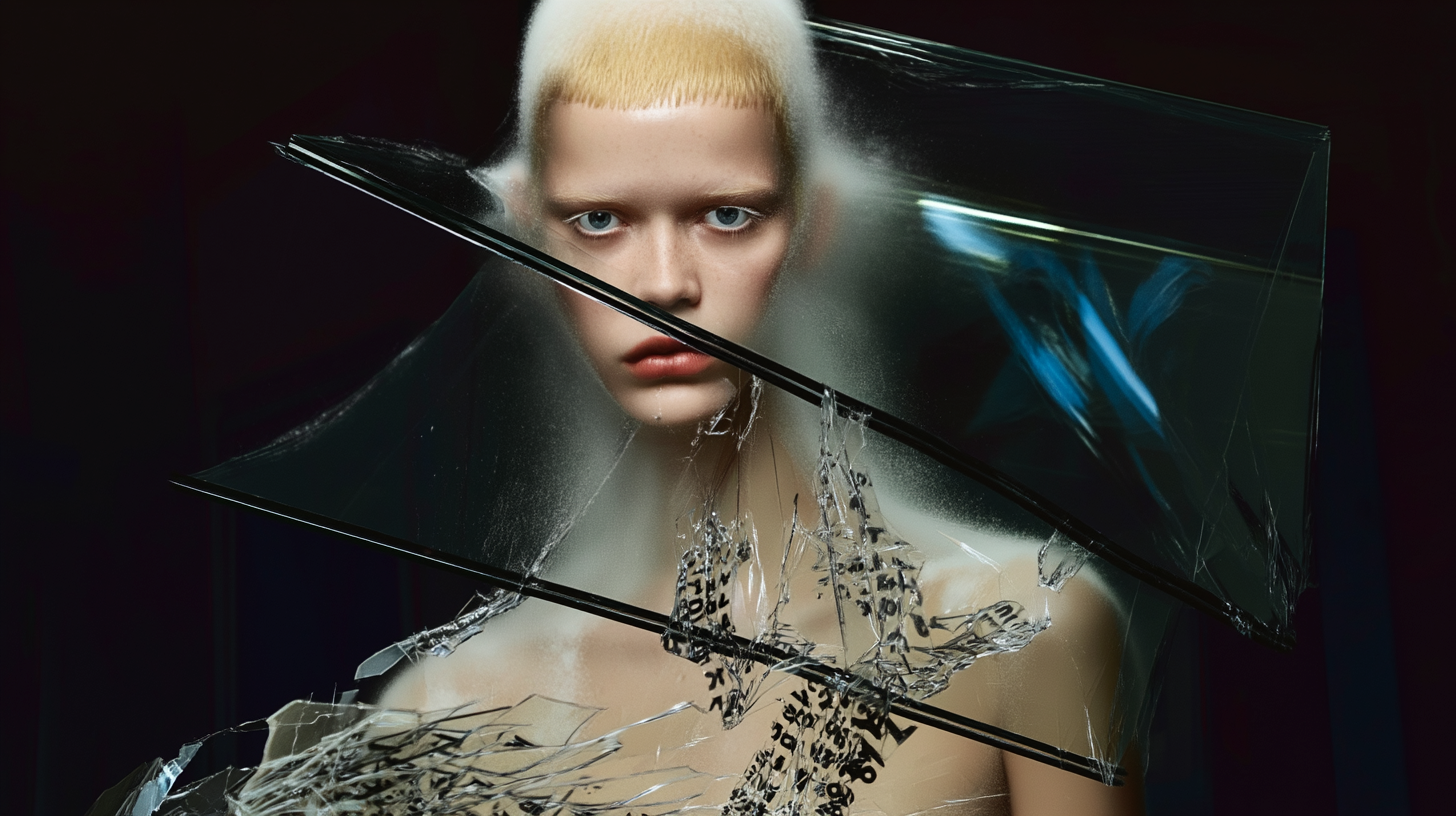
The other day in an office, I found myself looking at someone whose beauty stopped me before thought did. The face was fine-boned, the body slight, the presentation precise but not legible in the ordinary way. My first question arrived with embarrassing speed: was this a beautiful young man or a beautiful woman? Then came the second thought, which was less a correction than an exposure. Why had I asked at all?
I do not mean that curiosity itself is shameful. Curiosity is one of the better things in us. But there are different kinds of curiosity, and they do not feel the same in the body. One opens outward. The other reaches to classify, to settle, to restore a familiar order. I recognized in myself, in that instant, not simply interest but the reflex to place a person inside a grid before I had even allowed them the dignity of existing outside it.
That small moment stayed with me because it was so ordinary. It was not a scandal. No harm was done. I said nothing. The person remained entirely themselves, untouched by my internal sorting. But that is partly the point. So much of the world’s taxonomies work quietly. They pass across the mind with remarkable speed, separating, naming, fixing. We like to imagine that prejudice announces itself dramatically, with ugly language and obvious malice. More often it lives in old habits of perception.
“So much of the world’s taxonomies do their work in silence.”
Not long after, I watched Enigma, the HBO documentary about April Ashley and Amanda Lear. The film is partly about trans womanhood, partly about glamour, partly about the brutal and absurd public appetite to know what a person “really” is. One woman was compelled to defend her womanhood again and again, as if identity were something always under suspicion. The other built an aura around ambiguity itself, letting uncertainty circulate as part of the performance. The pairing is brilliant because it reveals two different arrangements with the same demand. One life organized around being forced to answer the question. Another around refusing to do so.

Poster for Enigma (2025), directed by Zackary Drucker. Used here as a reference image in connection with this essay’s discussion of gender, glamour, and legibility.
What struck me was not simply the cruelty of public scrutiny, though that is there. It was the hunger underneath it. Not know in the intimate sense, which is slow and humane and full of revision, but know in the flattening sense. Know once and for all. Know once and for all. Know enough to stabilize the person before them. The unknown, especially when attached to a body, still unnerves people more than they care to admit.
I have thought before about unconscious bias, even taken those Harvard tests from Blind Spot out of a genuine wish to discover what in me might still be operating beneath daylight consciousness. But a test is one thing. A moment in real life is another. Theory has a flattering distance to it. You can discuss bias abstractly and still be surprised when your own mind reaches for a category like a hand reaching for a railing in the dark.
What I admired in Enigma was not just courage, though there is courage in it. It was style. By style I do not mean clothes or performance alone, though those matter. I mean a relation to the gaze. Some people are hunted by it. Some learn to bend it. Some make a theater out of its stupidity. There is intelligence in that. There is also exhaustion. To be seen and misseen at once is not a modern phenomenon, but our language around it is still strangely clumsy. We keep talking as if the highest moral achievement were tolerance, a word I have never liked. Tolerance is thin. Tolerance still leaves one side with the power to permit the other’s existence.
Acceptance is better, but even that may not be enough. The deeper shift would be a loosening of the compulsion to resolve people so quickly. To let a face remain a face for a moment before turning it into evidence. To let beauty be destabilizing without rushing to repair the disturbance.
“To let a face remain a face for a moment before turning it into evidence.”
This is one reason Berlin has stayed in my mind for years. I do not mean that it is a utopia. It is not. No city is. But Berlin contains a historical irony that I find moving. A place once bound to murderous fantasies of purity now feels, in certain corners, radically uninterested in the policing of presentation. The city’s atmosphere, at least as I experienced it, had less to do with official virtue than with a kind of social looseness. People seemed less panicked by strangeness. Less eager to convert difference into a problem requiring explanation. Not good, perhaps, in the moralizing sense. Better in a more practical one. More breathable.
The strange thing is that the wish to belong and the wish to exceed categories are not opposites. They are often braided together. In Enigma, one remark stayed with me: the performers in the Paris trans scene were called “sisters” because they had gone to the same surgeon. The line is funny, a little brutal, and deeply human. We invent ourselves, but never alone. We borrow forms. We submit to ideals. We imitate one another in the hope of becoming singular. When I heard it, I thought absurdly of spin class at Equinox in the late 2000s, the women in the front row who also looked like sisters, their faces and bodies converging toward the same sanctioned image of desirability. Different world, same pressure. Even our rebellions can become schools of resemblance.
“We imitate one another in the hope of becoming singular.”
Which is why the fantasy of a wholly free self has never persuaded me. We are shaped by images, by eras, by appetites that are ours and not ours. The issue is not whether we are influenced. Of course we are. The issue is why certain kinds of self-making are treated as normal while others are treated as suspicious. Why one woman’s artifice becomes glamour and another’s becomes deceit. Why some performances of personhood are greeted as charming and others as fraud.
I return, then, to that office and the split second in which someone’s beauty became, in my mind, a question. Perhaps the real problem was not the question itself but the assumption hidden inside it, the belief that uncertainty is a lack to be corrected rather than an encounter to be endured. We are still, for all our enlightened language, creatures who want the world clarified too quickly.
But there may be another way of seeing, one closer to patience than mastery. To look without immediately reducing. To allow mystery to remain in circulation. To understand that a person is not a riddle waiting for our solution. The unknown is not always a threat to knowledge. Sometimes it is a limit placed on our vanity.
What would it mean to become more civilized in this particular way? Not more tolerant. Not even more inclusive, though those words have their place. I mean less eager to finalize each other. Less committed to the old reflex that says before I can meet you, I must know what you are.
I am no longer interested in the fantasy that we will someday transcend categorization entirely. Human beings classify. We always will. The better question is narrower and harder. Can we interrupt the speed of it?Can we notice when the mind begins to close around another person? Can we bear, even briefly, the beautiful fact that not everything vivid asks to be named on sight?
Film referenced:
Enigma (2025)
Directed by Zackary Drucker
HBO / Max documentary feature referenced in this essay as part of a broader cultural inquiry into ambiguity, beauty, and classification.
Further viewing / reference :
Enigma
April Ashley
Amanda Lear
Zackary Drucker
Image Credits & Fair Use
This essay includes low-resolution images of artworks and photographs for the sole purpose of commentary, critique, and educational analysis in accordance with fair use principles. Full credits and source links are provided. No infringement is intended, and works remain the property of their respective rights holders.
If this essay resonated with you – share it or save it.


One response to “The Beautiful Unknown”
[…] Companion essay: The Beautiful Unknown […]