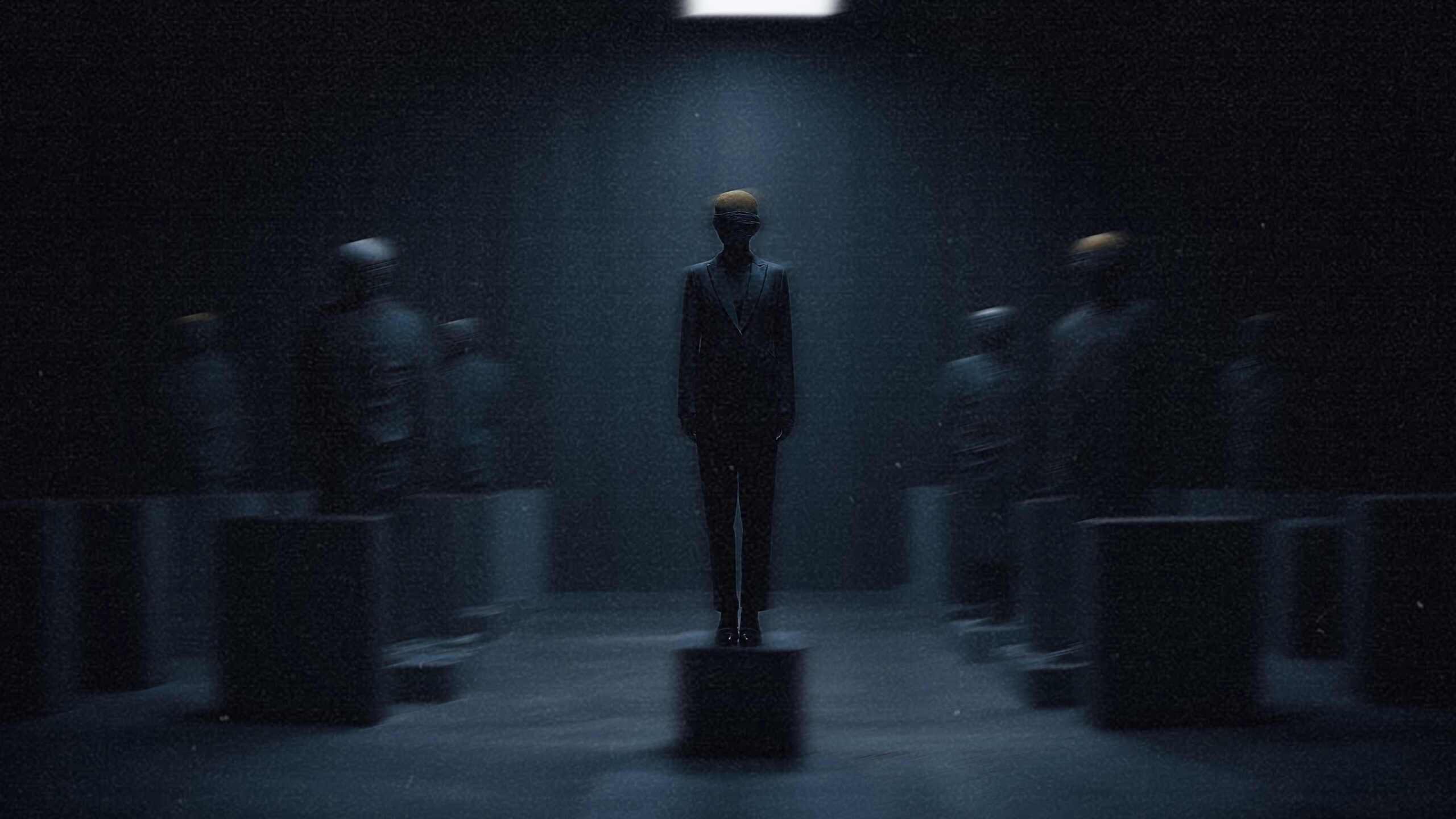
A respected vintage collector I follow posted a white dress from the current Gucci collection to his Instagram story. The caption praised its “special proportions.”
He is not a casual observer. He archives 1990s runway, documents fashion history, and has built a reputation around archive literacy. I respect his eye.
So I replied with a simple question: What about the proportions is special?

The object of the question. Where form was read as status before it was read as design.
Gucci, Spring/Summer collection. Courtesy of Gucci.
The first response listed construction elements: high neck, depth of armhole, heat seals, touches of black. That was fair. That is technical language.
Then came the pivot: if someone “just wants a white dress,” they can go to Walmart.
The conversation had shifted from form to status. I clarified my position. As an artist, I understand mission statements. I understand arcs. My point was narrower: the work did not translate for me. It felt formally flat.
His final message implied my interpretation sounded “wrong on many levels.”
That sentence lingered.
I wasn’t arguing about a dress. I was testing whether analysis is still allowed.
Not because I doubted my eye, but because I am precise about how conviction forms. When someone fluent in archive language reads innovation where I read repetition, I want to know what variables we are weighting differently. Memory? Market timing? Institutional loyalty? I set aside the instinct to withdraw and began tracing the lineage.
When Tom Ford assumed control of Gucci in 1994, the house was struggling. By the end of the decade, revenues had surged and Gucci Group had become one of the most powerful luxury conglomerates of its era. Contemporary reporting in The New York Times and later analysis in Business of Fashion document how Ford’s aesthetic overhaul coincided with dramatic financial growth.
Ford did not refine Gucci’s identity. He detonated it. High-gloss eroticism. Velvet tailoring worn like confession. Silk shirts unbuttoned to provocation. The campaigns, photographed by Mario Testino and Steven Meisel, were described at the time as “porno chic.” They reoriented the house’s temperature.
The shift was not only in tailoring but in attitude. Desire became the message.
Tom Ford for Gucci, 1996 campaign. Photo: Mario Testino.

Two decades later, Alessandro Michele enacted another rupture. Beginning in 2015, he displaced Ford’s hard sensuality with maximalist romanticism: logo excess, vintage eclecticism, gender fluidity. According to Kering’s annual financial reports, Gucci’s revenues more than doubled during Michele’s peak years. Again, aesthetic shift corresponded with structural transformation.
These were not subtle recalibrations. They were directional rewrites.

Rupture looks like this. A new syntax, not a refined version of the old one.
Tom Ford for Gucci, Fall/Winter 1996. Photo: Gucci Archive.
Restoration is not rupture.
The current recalibration under Demna reads differently.
Controlled eroticism returns, but within familiar limits. Not rupture. Calibration
Gucci, Spring/Summer collection. Courtesy of Gucci.

The tailoring sharpens. The erotic code returns. The palette darkens. Critics describe this as archival dialogue or house DNA restoration.
All of that may be accurate.
But restoration is not rupture.
Some eras reward rupture. This one rewards narrative control.
Innovation alters a house’s syntax.
Strategy reactivates a known one.
If Ford’s Gucci shocked because it felt dangerous and new, it did so within a media environment less saturated and less reflexive than today’s. Contemporary luxury exists inside an ecosystem of instant documentation, algorithmic amplification, and shareholder scrutiny. True rupture is riskier. Strategic continuity is safer.
So the debate may not hinge on whether Demna is clever. He is. It may hinge on whether the current climate permits a Ford-scale detonation at all.
There is also generational memory. Fashion rotates on a roughly twenty-to-thirty-year nostalgia cycle. What is archival to one viewer is revelation to another. Novelty is partly a function of exposure.
But novelty is not immune to comparison.
What interests me most is the social response to that comparison. In contemporary fashion culture, critique is often interpreted as disloyalty. Creative directors become symbolic anchors. To question proportion becomes to question belonging.
Whether we still have room to distinguish between transformation and recalibration.
Which raises a smaller, sharper question:
Whether we still have room to distinguish between transformation and recalibration without being told we “don’t understand.” And whether asking for that distinction is now considered impolite.
Further Reading
Image Credits & Fair Use
This essay includes low-resolution images of artworks and photographs for the sole purpose of commentary, critique, and educational analysis in accordance with fair use principles. Full credits and source links are provided. No infringement is intended, and works remain the property of their respective rights holders.
If this essay resonated with you – share it or save it.


Leave a Reply