When Shine Becomes a Method Rather Than a Mistake
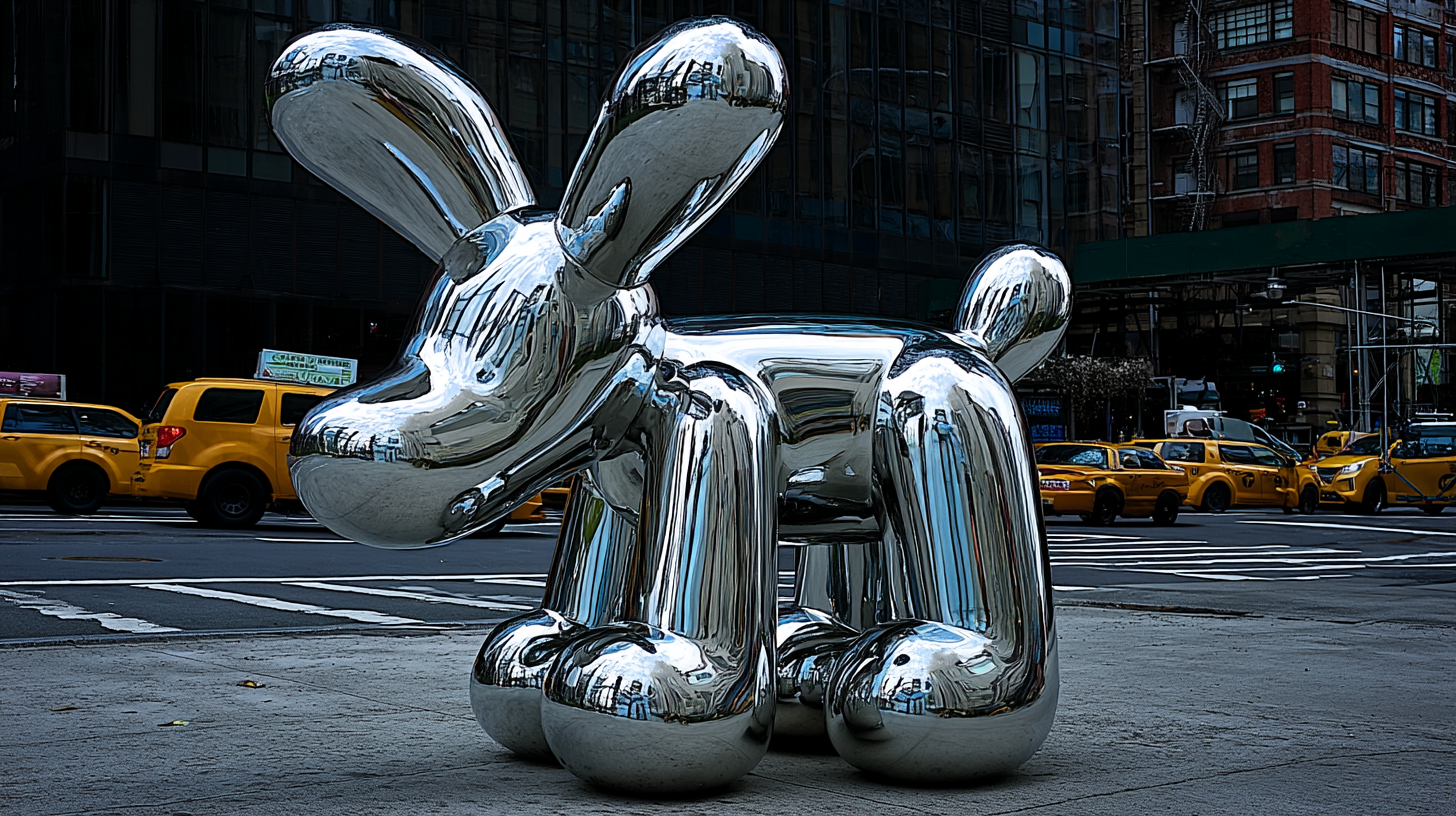
The first time I stood in front of a monumental balloon dog, I had the strange sensation of recognizing something before I had time to think about it. The object was enormous, mirror-bright, absurdly smooth. People walked up to it the way children approach a playground object, with a half smile that arrived before the mind had decided what it was looking at.
I remember wondering why.
Why did the surface feel so reassuring? Why did the form seem so instantly readable, even comforting, despite its scale and its price and its position inside a white cube gallery where comfort is not usually the point?
The answer, I suspect, begins with something simple. The work does not ask the viewer to struggle. It organizes the viewer’s perception from the first moment. Gloss, curvature, and color do a particular kind of work: they make desire legible. They tell the eye where to go and how to feel before thought has caught up.
I began to think of this not as kitsch or spectacle, but as a kind of engineering.
Video created using MidJourney and edited by the artist.
The polished toy aesthetic compresses a cluster of signals into one gesture. A flawless surface promises safety. Nothing here will cut you. Nothing here will stain you. The object appears immune to accident and therefore, in a subtle way, to time. A rounded silhouette produces recognition at a distance. The form rhymes with things we already know: balloons, cartoons, corporate mascots, objects designed to be friendly. Even the colors behave predictably. Saturation narrows interpretation. It gives the viewer a mood before the viewer has assembled one.
None of this is accidental.
It is easy to forget that a viewer rarely spends long minutes with a work before deciding how to approach it. Most encounters with art happen quickly. A glance across a museum room. A photograph on a phone screen. A sculpture glimpsed in the entrance of an auction house.
Studies in visual perception show that the brain forms a first impression of an image in a fraction of a second, long before conscious analysis begins.
The eye decides almost immediately whether the object is playful, serious, safe, or alien. The toy aesthetic solves this problem elegantly. It scripts the first two seconds.
Jeff Koons understood this earlier and more clearly than most people were comfortable admitting. His mirror-polished Balloon Dog sculptures are perhaps the clearest example of how a playful object can organize perception almost instantly.
To dismiss his work as kitsch has always seemed to me intellectually lazy. What is more interesting is the extraordinary control required to stage innocence so convincingly. The sculptures appear effortless, but the effort is immense. Entire teams labor to produce surfaces without flaws, colors without drift, reflections without distortion. The result is an object that performs certainty. It tells the viewer, without words, that everything here has been mastered.
Yet this mastery produces an odd effect. The mirror-like surface of many of these works literally reflects the viewer and the surrounding space. You see yourself, the gallery, the other spectators, all wrapped inside the skin of the object. The sculpture becomes a strange hybrid: toy, mirror, and stage set at once.
Watching people interact with such works, one notices a curious double reaction. The first impulse is pleasure. The object is funny, charming, photogenic. But very often another recognition follows quickly behind it: the awareness that one’s pleasure has been carefully arranged. The sculpture reveals how easily delight can be manufactured.
This ambivalence is not a failure of the work. It may be the work.
The toy object gratifies and exposes gratification simultaneously. It is both commodity and commentary on the conditions that produce commodities. The viewer stands in the middle of these two currents, enjoying the spectacle and noticing the machinery behind it at the same time.
At this point the familiar opposition appears: the raw artwork versus the polished one. The wounded surface versus the immaculate one. Authenticity versus spectacle.
But the more I think about it, the less convincing that opposition becomes.
The history of contemporary sculpture already hints at this: Pop artists like Claes Oldenburg turned everyday objects into playful monuments, while Minimalists such as Donald Judd established the authority of flawless industrial surfaces.
Both aesthetics are strategies for stabilizing meaning. Rawness signals contact with the body and with time. We see marks of touch, traces of risk, the residue of process. The polished object signals the opposite qualities: control, permanence, authority. In both cases the viewer is reassured. One reassures through vulnerability, the other through mastery.
The art world, perhaps inevitably, gravitates toward whichever signal travels fastest.
Yet polish does not automatically erase depth. It simply relocates where depth must occur.
A glossy object becomes interesting when its promises encounter resistance. Imagine a mirror-bright sculpture reflecting something uncomfortable: a surveillance camera, a crowd pressing too close, a street outside the museum that contradicts the fantasy of the gallery interior. Or imagine the object aging, slowly accumulating fingerprints and micro-scratches that puncture its illusion of invulnerability. The promise of perfection begins to crack, and thought enters through that crack.
The same thing can happen through context. A monumental toy placed inside a municipal hallway or a neglected public site begins to measure the social space around it. Who feels welcome here? Who does not? What does safety mean in that location?
In moments like these the object begins to think.
This is where the word fetish becomes useful, though it has to be handled carefully. In everyday speech the word often means obsession or bad taste. But historically a fetish object is something that has been asked to carry more belief than it reasonably can. It is an object that concentrates value, hope, fear, or power in excess.
The polished toy does something similar. It gathers belief around itself with remarkable efficiency. The surface tells us: this object is safe, joyful, permanent, valuable. It is already iconic. It deserves attention.
The question that interests me is not whether this is good or bad. The more interesting question is what happens when so much belief gathers around an object designed to look harmless.
Standing in front of one of these sculptures, I sometimes have the uneasy sense that I am looking at a machine for producing reassurance. A beautifully constructed device that converts uncertainty into pleasure. The device works extremely well. That is precisely why it deserves attention.
And yet the moment I start to think about it in this way, another question follows.
If the toy aesthetic is so effective at scripting the viewer’s first two seconds, what happens in the third, and the fourth, and the minute that follows?
Does the object continue to unfold, or does the script end there?
I suspect the answer to that question may be the real test of the work.
This essay is part of an ongoing exploration of how surfaces and signals operate in contemporary art.
Read the companion essay:
Fetish of the Raw →
Selected works related to the “toy” aesthetic

Jeff Koons, Balloon Dog, 1994–2000 — mirror-polished stainless steel with transparent color coating. (Various museum collections)
Jeff Koons, Rabbit, 1986 — stainless steel. (Collection of the Broad / various collections)


Takashi Murakami, Mr. DOB, various versions 1990s–present — fiberglass and lacquer. (Various collections)
KAWS (Brian Donnelly), Companion, 1999–present — painted cast vinyl / fiberglass. (Various installations and collections)


Anish Kapoor, Cloud Gate, 2004 — polished stainless steel. Millennium Park, Chicago.
Claes Oldenburg, Clothespin, 1976 — Cor-Ten steel public sculpture. Philadelphia.
Oldenburg did something extremely important decades before Koons:
He took ordinary objects and made them monumental.
This is the first major step toward the toy aesthetic.Instead of heroic subjects, sculpture becomes:
• playful
• familiar
• approachable


Donald Judd, Untitled (Stack), 1967 — galvanized iron and lacquered aluminum. (Various museum collections)
Judd introduced something that becomes crucial later:
industrial surface authority
Minimalism made:
• flawless fabrication
• industrial materials
• perfect edges
into a visual language of control and certainty.
Koons inherits that language and combines it with Pop imagery.
Image Credits & Fair Use
This essay includes low-resolution images of artworks and photographs for the sole purpose of commentary, critique, and educational analysis in accordance with fair use principles. Full credits and source links are provided. No infringement is intended, and works remain the property of their respective rights holders.
If this essay resonated with you – share it or save it.



One response to “Fetish of the Toy”
[…] Read the companion essay:Fetish of the Toy → […]